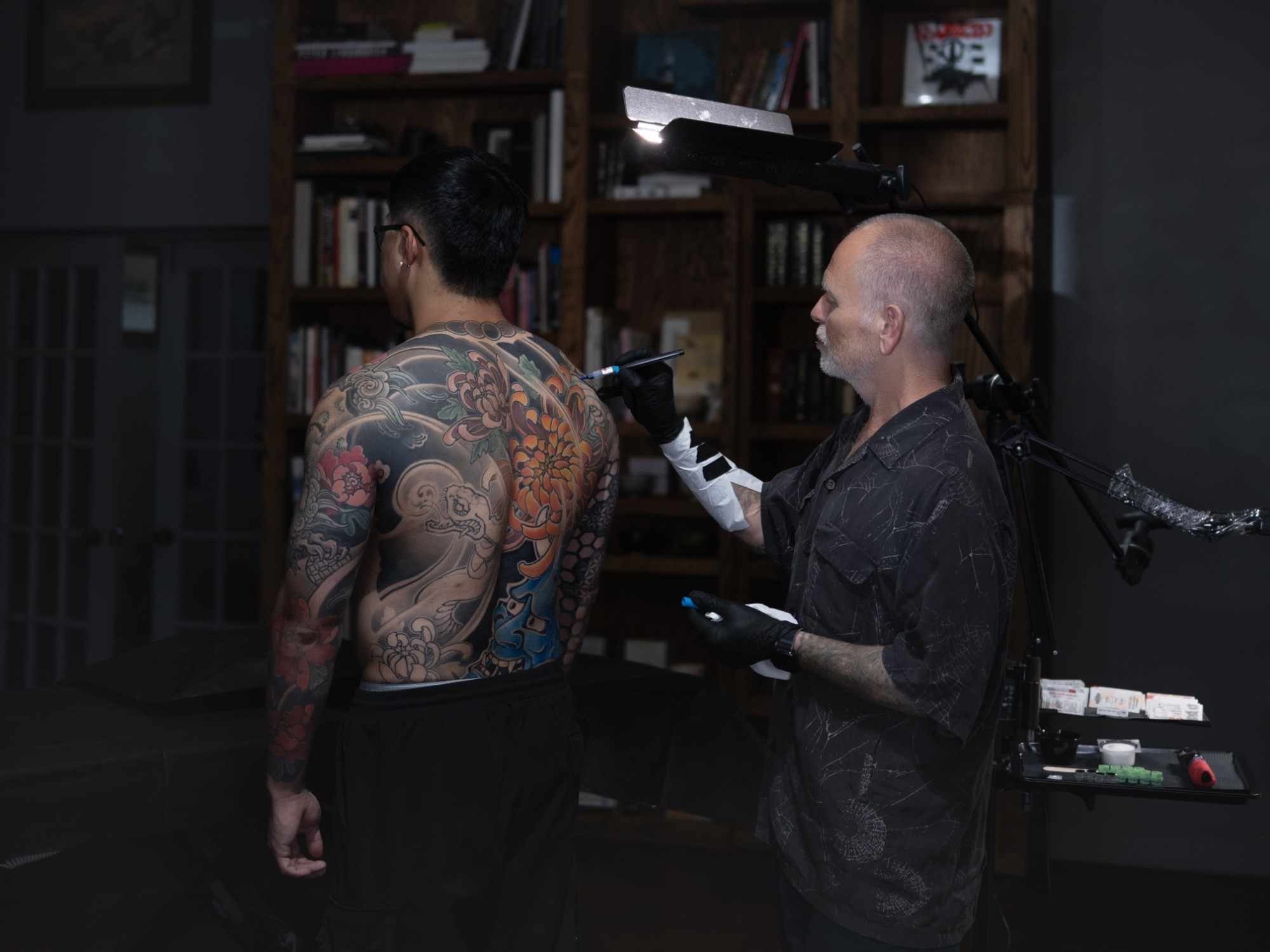
Most people picture a Japanese tattoo as a single image: a koi, a dragon, a tiger. George Bardadim, a tattoo artist in Brooklyn, builds that image into a composition for the body. He works in gendai irezumi, a contemporary practice rooted in Japanese tattooing. He starts with the main subject, then decides how much space it needs and how it should sit and move on the body.
We asked him how he plans a sleeve or a backpiece, which motifs people misunderstand, and what he wishes collectors knew before they book. He also walked us through two finished projects.
Drawing for the body, not the page
“When I plan a sleeve, I draw for an arm that bends and turns,” George says. “The main subject, the background, and the edge all have to work together.”
He uses a framed approach called gakubori, in which the main subject, the background, and the border are planned as one composition from the first sketch. “If it might become part of a larger piece later, I take that into account from the start.”
The motifs, and one misunderstanding
Dragons, koi, and tigers come up often, and what they mean depends on how they are drawn. “A koi swimming against the current can suggest perseverance,” he says. “The current is what makes that idea visible.”
One misunderstanding he hears involves the Dragon Gate story. Clients sometimes assume that a koi placed next to a dragon tells it. “In that story the fish becomes the dragon,” George says. “If a client wants that particular story, I'd rather show the transformation in one figure than ask two separate figures to explain it.”
Why the project comes before the booking
George does not take a booking until he has reviewed the project. First he decides whether the general idea fits the work he does. If it does, he and the client go through a separate project review covering the subject, the placement, and how much space the idea needs.
Only after we've agreed on the direction do I open booking. I develop the actual design later. I want the client to know what we've agreed to before they commit to appointments, and I need to know I can make the idea work on their body.
What a sleeve or backpiece takes
In George's studio, a sleeve often takes six to eight sessions, and a backpiece fifteen to twenty-five. “Those are planning ranges, not promises,” he says. Healing time between sessions comes on top of them.
For a bodysuit, he prefers to start with the back and plan how the other areas will connect to it. He usually establishes the outline and the dark foundation before moving into color and smaller details. The early sessions can look unfinished for a while, he says, “because we're building the whole piece, not finishing one corner at a time.”
Wearing a tradition that isn't yours
“I don't expect the client to be Japanese,” George says. “I do think it's worth understanding the subject you're choosing and where it comes from.”
Nobody has to arrive knowing the history. “If the idea has a personal meaning, tell me what it is, and we can talk about whether it makes sense in this tradition and how to draw it.”
What to bring, and what to leave out
References help when they explain what you like. “It's useful to know whether you're drawn to the subject, the movement, or just how much black there is,” George says. “Then I can design for you instead of trying to reproduce someone else's tattoo.”
He also designs for how a piece will read years from now. “That can mean leaving more space or taking something out, even when it looks good on the screen.”
Poppies and skull rocks: a full sleeve
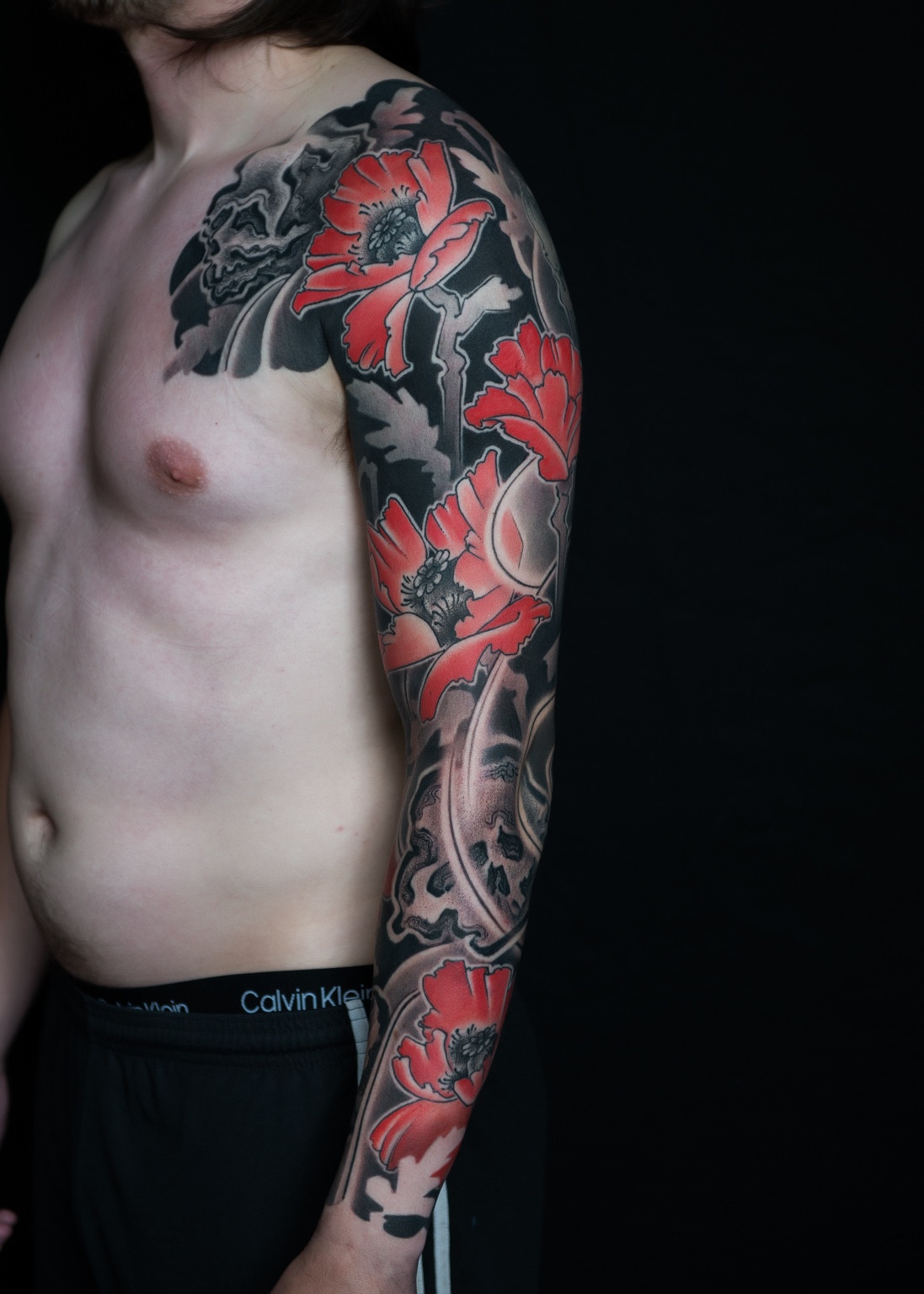
The client first asked for a flowing black-and-grey sleeve and was open to including skulls. The design they settled on follows poppies from bud to seed pod, with the skulls turned into small rocks so the flowers could stay the main subject.
The open blooms sit on the upper arm and forearm, where they read clearly. A wind spiral takes the elbow, and the seed pod sits on the shoulder blade. Partway through, the client asked what the flowers would look like in red. George showed him a rough color mockup, and they added vermilion at the very end. The sleeve took eight sessions.
Shoki the Demon Queller: a backpiece
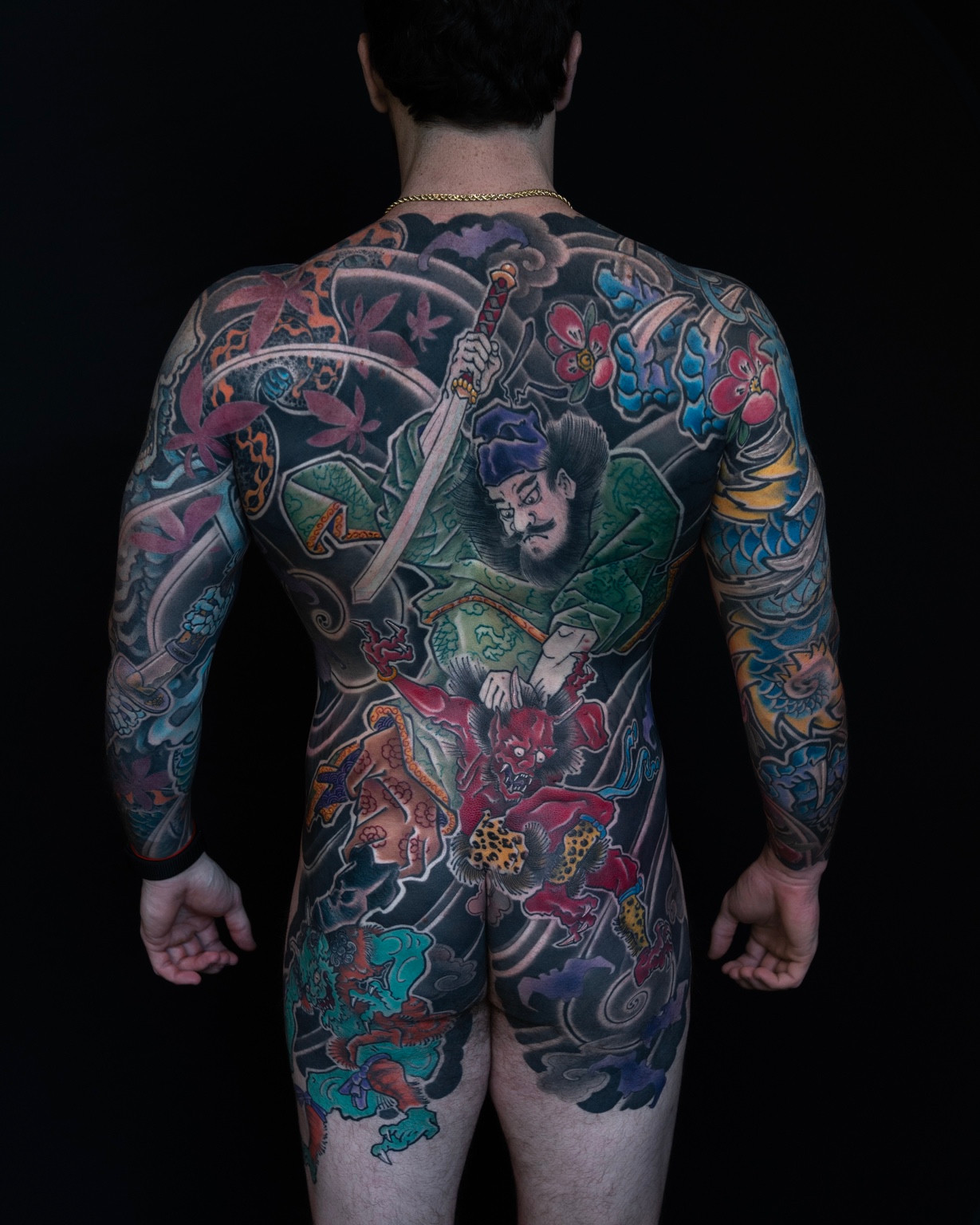
This project started with Shoki and the demons, and the backpiece also had to connect with work already on the client's shoulders. George built the scene around the moment Shoki catches one oni while another escapes toward the thigh. The main diagonal runs from the raised sword at the shoulder down to the caught oni in the lower back, and smoke ties the figures together and connects the back to the sleeves.
One small decision mattered more than it looks. George kept the bats as silhouettes, because at that scale more detail “would have made them harder to read and pulled attention away from Shoki's face.” The backpiece took twenty-one sessions.
Planning your own
A large Japanese piece starts with a conversation about the idea and the space it needs, well before a date goes on the calendar. See more of George's work on Ink Finder and on his own site, bardadim.tattoo, or browse Japanese traditional tattoo artists near you.